



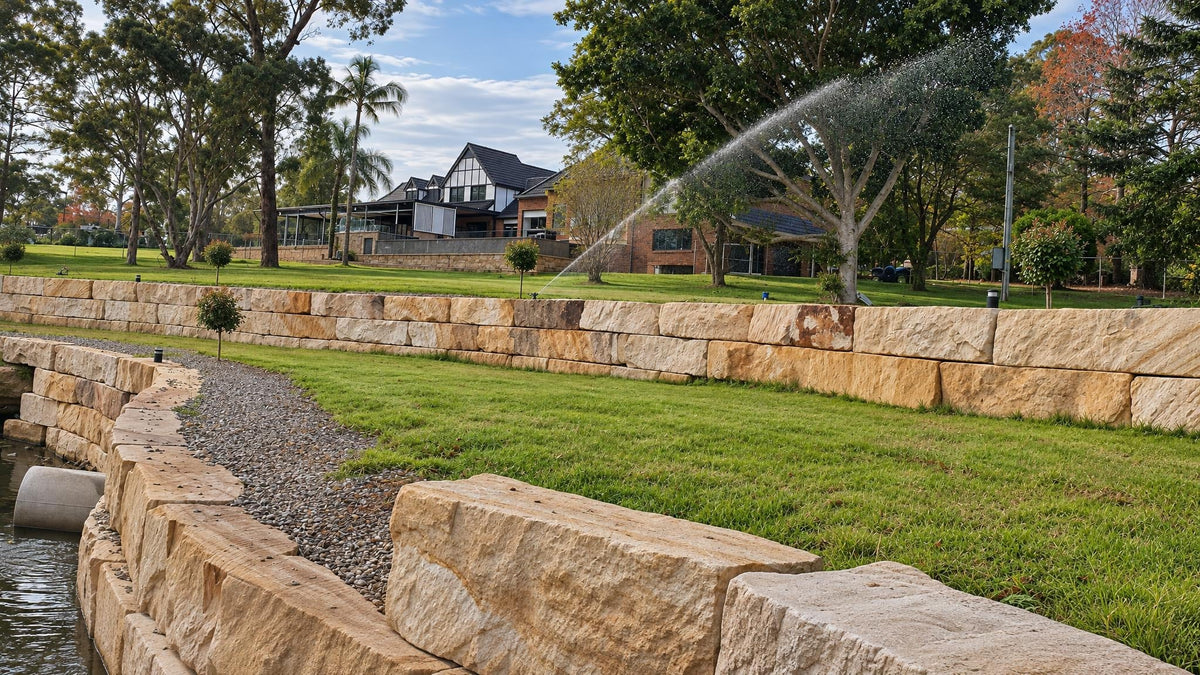
TL;DR Sandstone capping is the stone layer that sits on top of a wall, pier or garden edge and sheds water away from the structure below it. The three things that matter are the profile, the overhang and a full mortar bed. Get those right and capping lasts decades. This guide covers the main types, how to size it, how it is laid, and what to order. Martins Building & Landscape Supplies stocks sandstone capping and pier caps at our Dural yard, with delivery across Sydney. Call (02) 9651 1055.
Sandstone capping is the finishing detail that makes a garden wall, a letterbox pier or a front fence look deliberate rather than unfinished. It is also doing real work. Capping is the first line of defence for whatever is underneath it, and a poorly detailed cap will let water into a wall faster than any other single mistake on the job.
What sandstone capping is
Capping is a solid stone piece laid across the top of a masonry element: a garden wall, a pier, a retaining wall, a fence column, a step cheek. In Sydney the material is almost always local sandstone, either sawn or split, because it matches the look of the older walls that shaped the Hills District and the North Shore.
Unlike a paver, capping is not walked on. It is a roof for the wall.
Why capping matters more than it looks
It sheds water away from the wall
Masonry is porous. A wall with no cap, or a cap that is flush with the face, absorbs rain straight down into the mortar bed and the blockwork below. Over a few winters that shows up as efflorescence, then as cracked mortar, then as a wall that needs rebuilding.
It creates a drip edge
The overhang is what makes capping work. Water runs across the cap, reaches the edge and drips clear of the wall face instead of tracking back underneath. A cap that sits flush does not have a drip edge at all, which is why we always ask what the wall width is before quoting capping.
It finishes the detail
Honest answer: it also looks better. A wall with a properly overhanging cap reads as a completed piece of construction, and that matters on anything facing the street.
Types of sandstone capping
| Profile | Finish | Best for |
|---|---|---|
| Rough natural | Split top, natural edges | Rustic garden walls, bushland gardens |
| Rockface | Heavily textured face | Feature walls, piers with strong shadow lines |
| Hydrasplit | Even split finish | Cleaner contemporary walls, consistent thickness |
| Sawn smooth | Machine-cut, flat | Modern homes, rendered walls, crisp junctions |
| Bullnose | Rounded front edge | Low walls where people sit or brush past |
Rough and rockface profiles hide staining and age well. Sawn and hydrasplit profiles give you consistent thickness, which makes them easier to lay to a level line on a long wall.
Capping, pier caps and coping: what is the difference
These terms get used interchangeably on site, but they are not the same product.
| Term | What it means | Typical use |
|---|---|---|
| Wall capping | Long stones across the top of a linear wall | Garden walls, front fences, retaining walls |
| Pier cap | Square or rectangular cap for a column | Letterbox piers, gate posts, wall ends |
| Coping | General term for a protective top layer, any material | Pool edges, low walls, parapets |
If you are capping a wall with piers at the ends, you will need both. The long runs take wall capping, the piers take a pier cap sized to the pier, not to the wall.
How to size sandstone capping
- Overhang: allow roughly 20-30mm each side so the cap creates a proper drip line
- Thickness: 40mm is the practical minimum for garden work; go heavier on piers and driveways
- Length: longer pieces mean fewer joints, but check what you and a helper can actually lift
- Finish on the underside: a flat bed is easier to lay full and solid than a rough one
- Joint width: keep joints consistent, typically 5-10mm, so the run reads as one line
Measure the wall, not the drawing. Brick and block work rarely comes out at the exact drawn width. Measure the actual wall in three places and work from the widest point.
How sandstone capping is laid
- Check the wall is level and the mortar has cured before you load it
- Mix a stiff mortar, commonly around 3 parts sand to 1 part cement, and lay a full bed with no voids
- Butter the ends of each stone so the joints fill from the back, not just the face
- Tap each piece down to the string line rather than pushing it sideways into the bed
- Check the overhang on both faces as you go, not just at the end of the run
- Tool the joints neatly and clean mortar off the stone face before it sets
On long runs, allow for movement. A wall 15 metres long will move more than a 3 metre garden bed, and tight butt joints with no allowance is how capping ends up with hairline cracks after a summer.
Matching capping to the project
Garden walls and front fences
Sandstone wall capping on a 200-300mm wall is the classic Sydney front yard detail. Keep the profile consistent with the house: rough stone on an older brick home, sawn on a render and render home.
Piers and letterboxes
Commercial sandstone pier capping is where the detail gets noticed, because it is at eye level and it is the piece that stops a brick pier looking like an unfinished column. Size the cap to overhang the pier on all four sides, and consider a thicker section for a chunkier look.
Retaining walls and steps
On retaining walls the cap doubles as a finish and a seat in many gardens, so go heavier and consider a bullnose edge. On steps, capping should line through with the tread so the detail reads continuously.
Ordering, weights and delivery
Sandstone is heavy, so plan the delivery before you order. As a working estimate, sandstone runs at roughly 2.3 to 2.4 tonnes per cubic metre, which puts a 500 x 250 x 40mm cap at somewhere near 12kg. That is one-handed. A 900mm length is not.
| Element | Order in | Plan for |
|---|---|---|
| Garden wall cap | Lineal metres plus 10% | Two people, or a pallet close to the wall |
| Pier caps | Pieces, one per pier | Confirm pier width before cutting |
| Long runs | Lineal metres, allow for joints | Consistent lengths to reduce cutting on site |
Frequently asked questions
How much overhang should sandstone capping have?
Around 20-30mm past the wall face on each side. The overhang creates the drip edge that keeps water off the wall below.
What is the difference between a pier cap and wall capping?
A pier cap is a square or rectangular cap sized to a column. Wall capping is long stone laid along a linear wall. A wall with piers usually needs both.
How thick should sandstone capping be?
40mm is a practical minimum for garden walls. Go heavier on piers, retaining walls and anywhere the cap may be sat on or walked across.
Can sandstone capping be laid on rendered walls?
Yes. Sawn or hydrasplit profiles usually suit rendered walls better because a consistent thickness gives a crisper line.
How much does sandstone capping weigh?
Sandstone runs at roughly 2.3 to 2.4 tonnes per cubic metre. A 500 x 250 x 40mm cap is around 12kg, so plan lifting and access before delivery.
Do I need to seal sandstone capping?
Sealing is optional. It can help with staining and make cleaning easier, but sandstone has been used externally in Sydney without sealer for well over a century.
How do I match new capping to an old sandstone wall?
Bring a photo and the wall dimensions. Profile, colour and thickness all vary between quarries, so matching is easier from a sample than from a description.
Do you deliver sandstone capping in Sydney?
Yes. Martins Building & Landscape Supplies delivers palletised sandstone capping across the Sydney metropolitan area from our Dural yard. Call (02) 9651 1055.
Price your capping from the Dural yard
Send us the wall length, wall width and pier count and we will come back with quantities, profiles and delivery. Pick up available six days.


